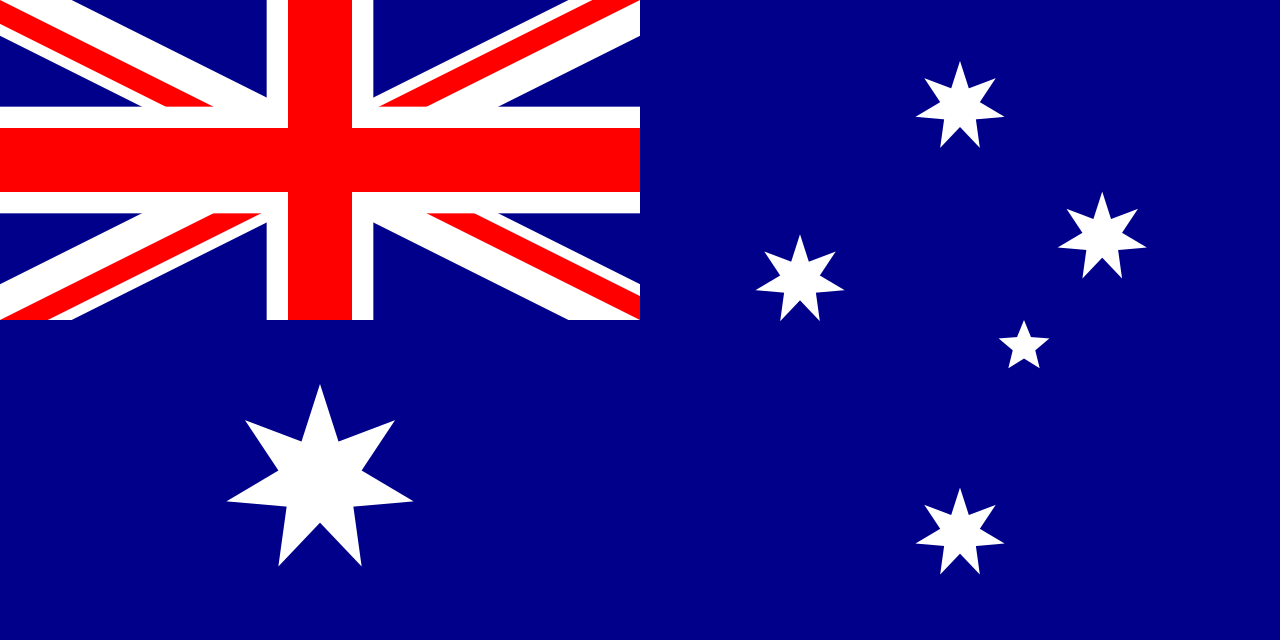
Australia’s 1:2 flag places the Union Jack in the canton, a seven-pointed Commonwealth Star below it, and five stars of the Southern Cross across the fly.
Specification
The flag is twice as long as it is high. The Union Jack occupies the upper hoist quarter. A large seven-pointed Commonwealth Star is centered in the lower hoist quarter; the fly carries four seven-pointed stars and one smaller five-pointed star forming the Southern Cross.
Official color references
PANTONE 280 / official referencePANTONE 185 / official referenceUnprinted field and starsConstruction notes
Schedule 1 fixes each star’s center and diameter relative to the fly. The Commonwealth Star’s outer diameter is three tenths of the flag’s hoist. Four Southern Cross stars have seven points and an outer diameter of one seventh of the fly; the smaller Epsilon Crucis has five points and an outer diameter of one twelfth.
Historical record
The winning design from a national competition was first flown on 3 September 1901. Five entrants—Annie Dorrington, Ivor Evans, Leslie Hawkins, Egbert Nuttall, and William Stevens—were declared joint winners. The Commonwealth Star gained a seventh point in 1908, and the Flags Act 1953 established the blue flag as the Australian National Flag.
Source trail
Australian Government: Australian National Flag elements and history ↗
Department of the Prime Minister and Cabinet: Australian Flags construction sheet ↗
| Star | Points | PM&C measurement baseline | Outer diameter | Equivalent using full length L |
|---|---|---|---|---|
| Commonwealth Star | 7 | Flag width (H) | 3H/10 | 3L/20 |
| Alpha Crucis | 7 | Width of fly (H) | H/7 | L/14 |
| Beta Crucis | 7 | Width of fly (H) | H/7 | L/14 |
| Gamma Crucis | 7 | Width of fly (H) | H/7 | L/14 |
| Delta Crucis | 7 | Width of fly (H) | H/7 | L/14 |
| Epsilon Crucis | 5 | Width of fly (H) | H/12 | L/24 |
Reading the construction measurements
The PM&C construction sheet, printed page 4, uses “width of fly” for the vertical dimension H. The preserved imported notes shorten this to “fly” and leave Epsilon’s baseline unstated. Reading those fractions against the full horizontal length would double the Southern Cross stars’ diameters. Use H/7 for the four larger stars and H/12 for Epsilon. The imported Commonwealth Star diameter, 3H/10, agrees with the sheet. The length-based equivalents above are calculated using L = 2H.
Physical color guidance and screen swatches
PM&C’s color guidance lists PANTONE 280 for blue and PANTONE 185 for red. These are physical color references. The imported hexadecimal swatches—#00008B, #FF0000 and #FFFFFF—are illustrative screen approximations, not certified PANTONE equivalents or production specifications. The imported phrase “Unprinted field and stars” does not establish a manufacturing requirement: it should not be read as requiring unprinted fabric or any particular printing or sewing method.
Flag terms and the six stars
The hoist is the edge attached to the pole; as a measurement, it means the flag’s height. The fly is the free end; in a hoist:fly ratio, fly means the full horizontal length. The canton is the upper corner beside the pole, occupied here by the Union Jack.
There are six stars: one seven-pointed Commonwealth Star and five Southern Cross stars. The latter comprise four seven-pointed stars and the smaller five-pointed Epsilon Crucis. See PM&C’s explanation of the flag’s elements.