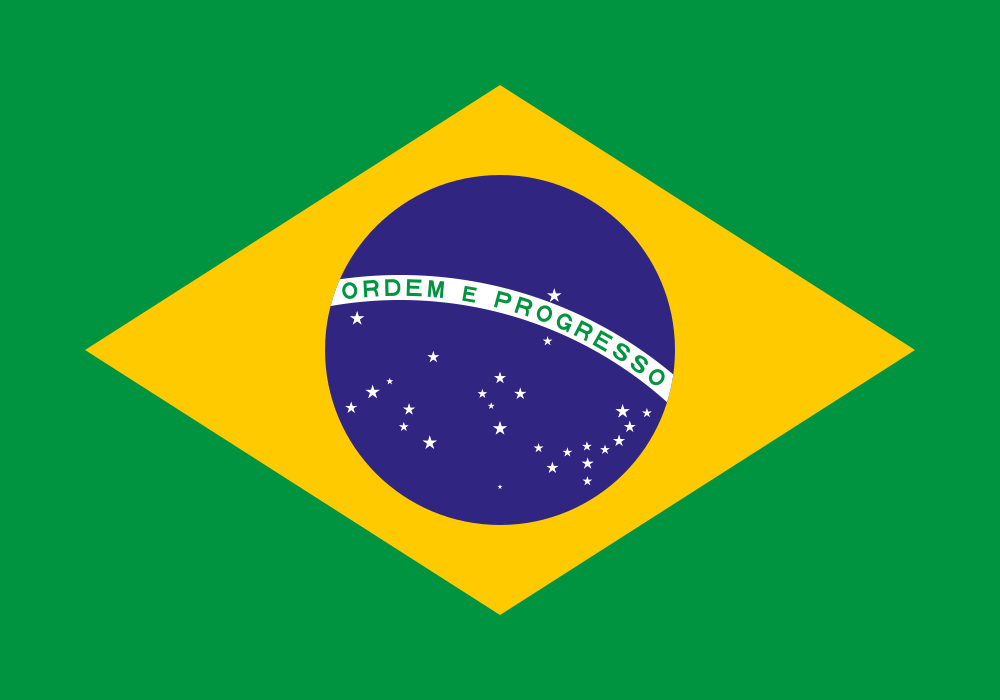
Brazil’s flag places a yellow diamond on green, with a blue celestial sphere, 27 white stars, and a rising white band carrying the motto “Ordem e Progresso.”
Specification
Federal Law 5,700, as amended by Law 8,421, defines the national flag on a 14-by-20 module field. The star field represents the sky over Rio de Janeiro at 8:30 a.m. on 15 November 1889, viewed from outside the celestial sphere; each star corresponds to a state or the Federal District.
Display colors
HEX #009440 / asset screen valueHEX #FFCB00 / asset screen valueHEX #302681 / asset screen valueConstruction notes
Divide the hoist into 14 equal modules and set the fly to 20. Place each diamond vertex 1.7 modules from the nearest outer edge. Center the blue circle at the intersection of the flag’s axes and use a 3.5-module radius. The motto, curved band, letter spacing, and differently sized stars should be taken from the legal construction sheet rather than approximated as generic text and dots.
Historical record
The republican design was established four days after the proclamation of the Republic in November 1889. Its star field has changed as the federation changed. The 1992 amendment brought the flag to 27 stars, representing 26 states and the Federal District.
Source trail
Presidency of Brazil: consolidated Law 5,700 on national symbols ↗

Understanding the construction measurements
Hoist means the flag’s height; fly means its length. One module equals one fourteenth of the height. The specified field is 14 modules high and 20 modules long, so its hoist:fly ratio is 14:20, which reduces to 7:10 by dividing both numbers by two.
Each vertex of the yellow diamond sits 1.7 modules inward from its nearest outer edge: a distance of 1.7/14 of the flag’s height. The blue circle is centered on the flag and has a radius of 3.5 modules, measured from its center to its edge. That radius is one quarter of the flag’s height, making the circle’s diameter half the height. The imported construction notes retain the guidance for the curved band, lettering and differently sized stars.
Limits of the displayed colors
The listed HEX values—green #009440, yellow #FFCB00 and blue #302681—are screen values from the supplied artwork. They are not established here as print, textile or statutory color standards and should not be treated as official manufacturing requirements. The artwork’s existing provenance remains applicable; no Pantone, RGB or CMYK specification is established by these display values.
Frequently Asked Questions
Why does Brazil’s flag have 27 stars?
The 27 stars represent Brazil’s 26 states and the Federal District. The 1992 amendment brought the star field to this total.
What sky does the emblem represent?
The emblem represents the specified sky over Rio de Janeiro at 8:30 a.m. on 15 November 1889, viewed from outside the celestial sphere. That viewing convention matters when interpreting the arrangement of the stars.
Why does the record give both 1889 and 1992 dates?
19 November 1889 is the first-adoption date of the republican flag design. 11 May 1992 dates the later amendment associated with the current 27-star field. The dates describe different stages of the design’s history.