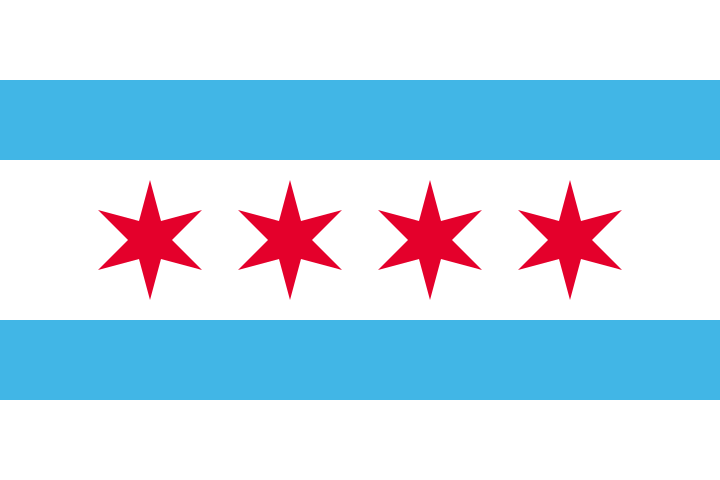
Chicago’s white flag has two light-blue horizontal bars and four six-pointed red stars. The bars divide the field into three white bands, with the stars centered in the middle band.
Design structure
The two blue bars represent the city’s major waterways: the upper bar for Lake Michigan and the North Branch of the Chicago River, and the lower for the South Branch and the Great Canal. The three white fields stand for the city’s north, west, and south sections.
Display colors
Screen approximationScreen approximationA flag that accumulated history
Wallace Rice designed the original two-star flag adopted in 1917. A third star was added in 1933 for the Century of Progress exposition, and a fourth followed in 1939 for Fort Dearborn. Each star’s six points carry a separate set of meanings.
Construction notes
Use six-pointed stars drawn specifically for the flag; conventional five-pointed stars are not substitutes. The code describes the field, stripes, and devices, while many physical reproductions use a 2:3 format.
Source trail
Office of the City Clerk: Municipal Code of Chicago, §1-8-030 ↗
| Position | Commemoration | Added to the flag |
|---|---|---|
| 1 — nearest the flagpole | Fort Dearborn | 21 December 1939 |
| 2 | Great Chicago Fire, 8–10 October 1871 | 1917 — original design |
| 3 | World’s Columbian Exposition, 1893 | 1917 — original design |
| 4 — farthest from the flagpole | Century of Progress, 1933 | 9 October 1933 |
What the six points mean
The Chicago Public Library explicitly describes point symbolism as unofficial and variable. Its examples associate Fort Dearborn’s points with successive governing authorities; the Fire star’s with transport, work, trade, finance, population and health; and the Columbian Exposition star’s with faith, learning, beauty, justice, generosity and civic spirit. For the Century of Progress star, it lists historical city-size symbolism and civic mottos or nicknames. These interpretations are distinct from the Code’s prescribed star design and commemorations.
Specification and specimen limits
The imported record attributes the design to the Municipal Code, labels 2:3 as customary manufacture and identifies its displayed colors as screen approximations. Those qualifications remain in force for this specimen.
Municipal Code §1-8-030 describes the field, bars and stars, and also gives preferred proportions: 2:3 or 3:5 for hand-carried banners, 1:2 for flags flown from masts and staffs, or dimensions prescribed for the United States national ensign. The structured value “2:3 customary” therefore does not describe the only official format. The section names blue and bright red without supplying numerical color coordinates. This specimen is not a certified construction drawing or a physical-color standard.
How to use the sources
The City Clerk’s Municipal Code page is a gateway to the code publisher, rather than the text of the flag provision. Consult the separately cited §1-8-030 for design, star order and preferred proportions.
The existing Chicago Design System page concerns the Y-shaped Municipal Device. It provides related municipal-symbol context, not evidence for the complete flag specifications or star chronology. The Public Library’s Municipal Flag section supports the addition dates and qualified symbolism; the Chicago Architecture Center supports the adoption date and visual description.
The customary-manufacture label and screen-color qualifications are retained from the imported record, not presented as independently certified manufacturing evidence. The original source trail and artwork provenance are preserved.
Sources and their scope
- Office of the City Clerk — Municipal Code gateway; retained imported source.
- Chicago Design System — Municipal Device context; retained imported source.
- Municipal Code §1-8-030 — flag design, hoist-to-fly commemorations and preferred proportions.
- Chicago Public Library, Chicago Facts — Municipal Flag section.
- Chicago Architecture Center, The Chicago Flag — adoption and visual description.