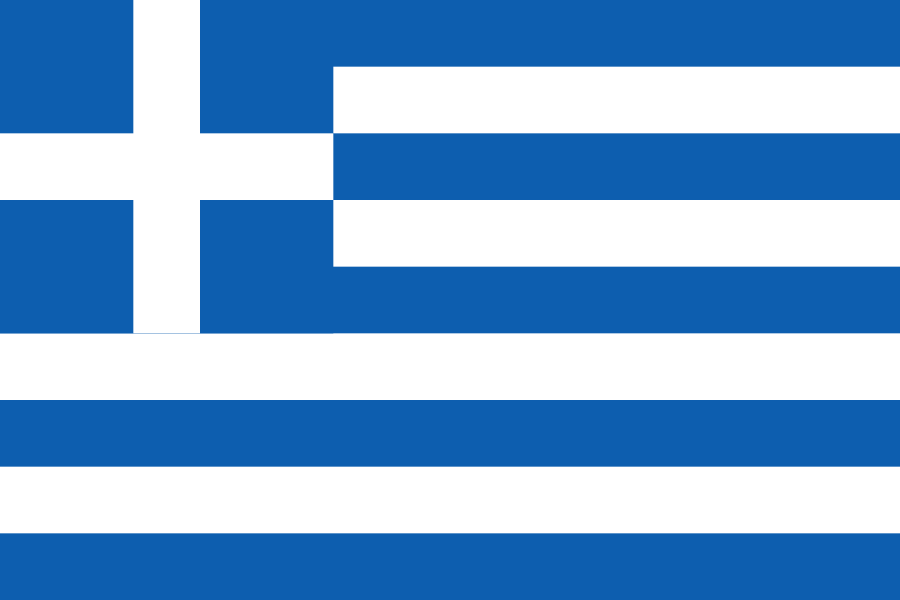
Greece’s flag has nine equal alternating blue and white horizontal stripes and a blue square canton bearing a white cross.
Specification
Five blue and four white stripes alternate across a 2:3 field, beginning and ending with blue. The square canton at the upper hoist is five stripe-widths on each side. Its white cross has arms exactly one stripe-width thick and reaches all four canton edges.
Display color
HEX #0D5EAF / display referenceConstruction notes
Divide the height into nine equal units and the length into 27 half-units, producing a convenient 18-by-27 construction grid. The canton measures ten by ten half-units. Center two-unit-wide vertical and horizontal white bars within it.
Historical record
Blue and white national flag types were established by the First National Assembly at Epidaurus in January 1822. The striped form was originally associated with maritime use; merchant and naval forms were consolidated in 1828. Later changes largely concerned royal devices. Law 851 of 1978 established the present striped design as the national flag.
Source trail
Reading the construction grid
Each grid unit equals half a stripe’s thickness. In these consistent units, the existing construction is 18 units high and 27 units long. The hoist is the edge nearest the flagpole; the square canton occupies the upper corner at that edge. Center the horizontal and vertical white cross bars within the canton, extending them to its edges. The table restates the geometry in the imported construction notes using the same unit throughout.
| Element | Dimension in grid units |
|---|---|
| Overall height | 18 |
| Overall length | 27 |
| Each stripe's thickness | 2 |
| Square canton (height × width) | 10 × 10 |
| Each white cross bar's thickness | 2 |
Limits of the displayed blue
The blue #0D5EAF is this page’s screen display reference, as labelled in the imported specification. It should not be treated as an official production colour specification. The legal geometry, any separately documented manufacturing guidance, and this screen approximation are distinct: the illustration does not establish a manufacturing colour standard.
Frequently Asked Questions
When was the Greek flag originally adopted?
January 1822 refers to the original blue-and-white national flag types established by the First National Assembly at Epidaurus. In the supplied historical account, the striped form was originally associated with maritime use, and merchant and naval forms were consolidated in 1828. This origin date does not mean that today’s legal form has been in uninterrupted use since 1822.
When was the current legal form adopted?
The record identifies 22 December 1978 as the date of the current legal form and cites Law 851/1978 for establishing the present striped design as the national flag. This is distinct from the January 1822 origins of the blue-and-white flag types and the striped design’s earlier maritime association.