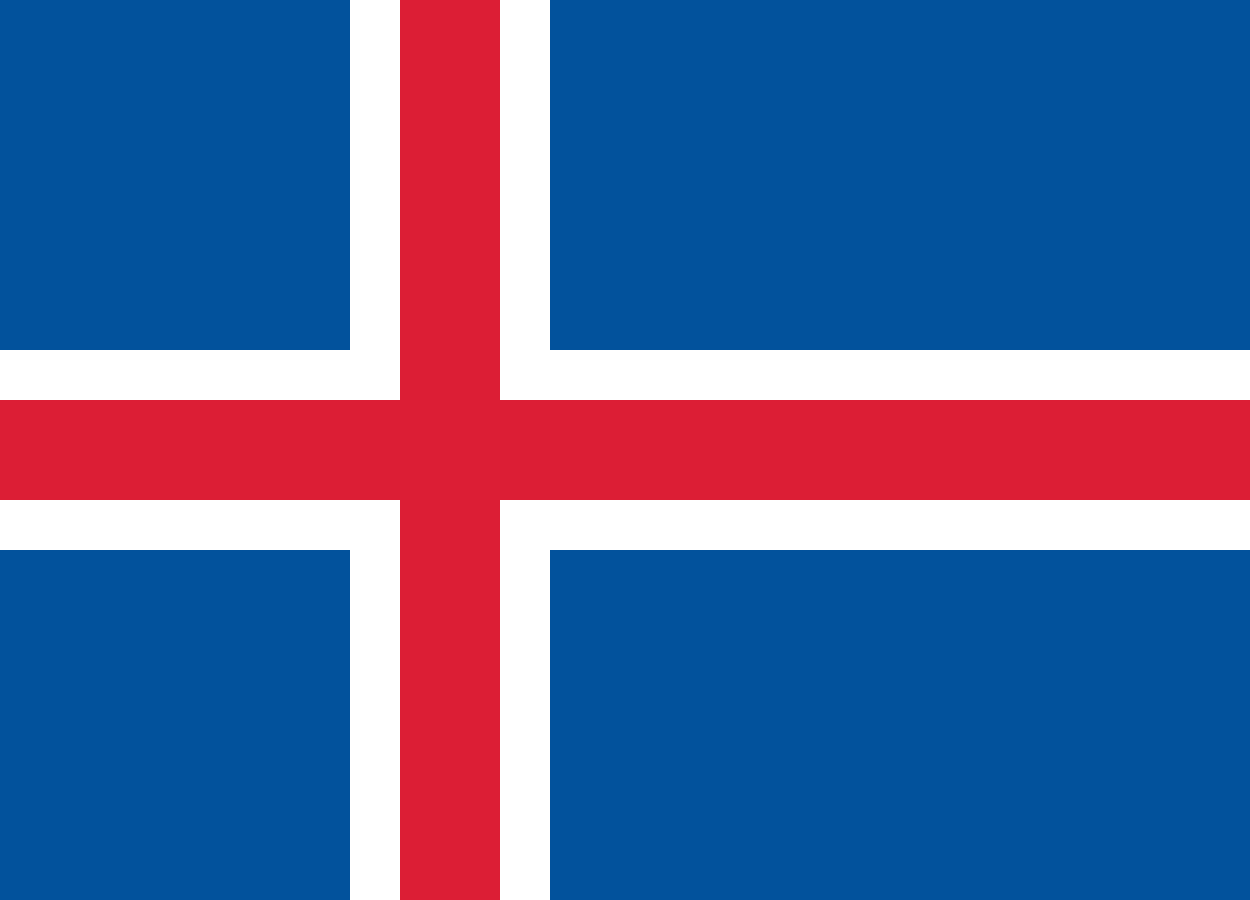
Iceland’s 18:25 flag has a red Nordic cross edged in white on a blue field. Its grid divides 7:1:2:1:7 vertically and 7:1:2:1:14 horizontally.
Specification
The flag law describes a sky-blue field carrying a snow-white cross with a fiery-red cross inside it. The complete white cross is four eighteenth-parts of the hoist and the red cross is two eighteenth-parts, leaving a one-unit white border on each side in an 18-unit grid.
Display colors
HEX #02529C / asset screen valueHEX #DC1E35 / asset screen valueHEX #FFFFFF / RGB 255, 255, 255Construction notes
Draw a four-unit white Nordic cross on an 18-by-25 blue rectangle, then center a two-unit red cross over it. The hoist fields are seven-unit squares and the fly fields are twice as long. The swallowtailed state flag is a separate legally defined form.
Historical record
The blue, white, and red design received official recognition in 1915 and became the national flag when Iceland became a sovereign kingdom in 1918. On the establishment of the republic, the first law confirmed by the new president on 17 June 1944 restated the flag and its construction.
Source trail
Althingi: Act 34/1944 on the national flag and state coat of arms ↗
How to read the construction
For the rectangular general national flag, hoist means height and fly means length: the flag is 18 units high and 25 units long. Read 7:1:2:1:7 from top to bottom, and 7:1:2:1:14 from the hoist edge to the fly edge. In each sequence, the divisions represent blue field, white border, red cross, white border, and blue field.
The complete white cross is four units wide. The two-unit red cross is centered within that white cross, leaving a one-unit white border on each side. The Nordic cross is offset toward the hoist: centering the red cross within the white cross does not mean centering it on the whole flag. The blue fields beside the hoist are seven-unit squares; those toward the fly are seven units high and fourteen units long.
Limits of the display colors
All three listed HEX values—blue #02529C, red #DC1E35, and white #FFFFFF—are display values for the supplied specimen. They are screen approximations, distinct from the law’s verbal descriptions of sky-blue, snow-white, and fiery-red. This record does not establish physical manufacturing color targets, customary manufacturing matches, or certified Pantone or CMYK equivalents.
Frequently Asked Questions
Why does this record mention 1915, 1918, and 1944?
These dates describe different milestones. The blue, white, and red design received official recognition on 19 June 1915. It became the national flag when Iceland became a sovereign kingdom in 1918. On the establishment of the republic, the law confirmed on 17 June 1944 restated the flag and its construction. The dates therefore distinguish recognition of the design, national status, and the republic’s legislation.
Does the 18:25 construction also describe the swallowtailed state flag?
No. The 18:25 ratio and construction given here describe the rectangular general national flag. The swallowtailed state flag is a separate legally defined form; this record’s rectangular construction should not be treated as its specification.