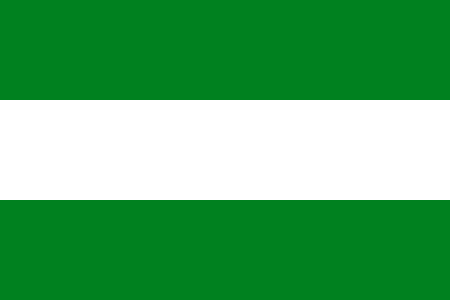
Rotterdam’s flag is a 2:3 horizontal triband of green, white, and green. All three bands are equal in height.
Design structure
The flag reduces the central field of Rotterdam’s arms to three broad stripes. Matching green bands frame a white center band, producing a symmetrical civic banner with no separate charge.
Display colors
HEX #00811F / official digital valueHEX #FFFFFF / RGB 255, 255, 255Construction notes
Divide a 2:3 rectangle into three equal horizontal bands. Fill the upper and lower thirds with Rotterdam green and leave the middle third white. The uncharged triband is the official form; versions bearing the complete arms are variants.
Historical record
The municipality adopted the flag on 10 February 1949. Its colors come from the city’s arms: Rotterdam describes the green field as divided by a white band representing the Rotte, the waterway from which the city takes its name.
Source trail
Municipality of Rotterdam: visual identity and city symbols ↗

What the displayed green establishes
The imported section labels #00811F an “official digital value.” Here it should be understood as the displayed rendering value: the evidence checked does not establish that hexadecimal value as an official flag standard. The municipal Huisstijl page concerns communications and visual identity. A branding color requires explicit flag-specific evidence before it can be treated as a flag specification.
Screen values, customary textile colors and official manufacturing requirements are distinct. No verified flag-specific passage supplied here establishes a textile color target or manufacturing tolerance.
Evidence by claim
- Adoption: The official information record for Besluit betreffende de vlag der Gemeente identifies Rotterdam’s municipal council, records 10 February 1949 as both signature and commencement date, and identifies Gemeenteblad 1949-6. This supports the adoption date retained from the imported record; the linked decision attachment was not retrieved.
- Proportions: The 2:3 hoist-to-fly ratio is retained from the imported record. The existing Commons artwork source reports dimensions of 450 × 300, consistent with that ratio. Artwork dimensions corroborate the rendering, but do not independently establish a statutory construction requirement.
- Heraldic colors and the Rotte: The indexed text of the municipal Huisstijl handboek, version 2.0, March 2022, section 04, “Kleur,” printed page 23, describes the white band in the green field of the arms as symbolizing the Rotte and connects the flag with the same green–white–green colors. This supports the municipality’s stated interpretation and the shared armorial colors. The complete PDF was not retrieved during this check.
- Registration: The Commons licensing template makes a general statement about Dutch municipal flags and registration with the Hoge Raad van Adel. A Rotterdam-specific registration entry or reference has not been verified here. The imported registration claim therefore remains unconfirmed; the generic template does not substantiate it.
Displayed artwork provenance
The displayed specimen is the existing local asset asset_8e6b04860277c7e5e45d1615, recorded as “Vector by Andreas Trepte; locally simplified from the Commons rendering.” It is a local reference rendering, not a verified official construction drawing.
The existing Commons source credits Andreas Trepte and identifies municipal visual-identity colors as its source. Its licensing section carries public-domain notices, while its Summary also retains a CC BY-SA 2.5 notice. The local asset’s recorded rights statement remains “Public domain under Dutch municipal-flag provisions; official-insignia caveat.” That caveat remains relevant independently of the artwork’s recorded copyright status.