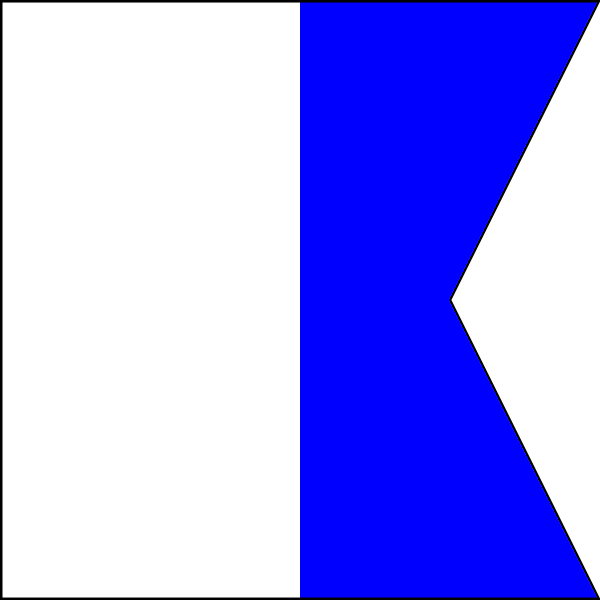
“I have a diver down; keep well clear at slow speed.”
Signal structure
Alpha is divided vertically, white at the hoist and blue toward the fly, with a triangular section removed from the fly to form a swallowtail. Its shape helps distinguish it from the rectangular letter flags around it.
Operational use
The flag communicates a vessel-related diving operation, not the position of every individual free-swimming diver. Navigation rules may require a rigid replica at least one metre high when diving operations restrict a small vessel’s ability to manoeuvre.
Do not confuse it with
The familiar red field with a diagonal white stripe is a recreational diver-down flag used under national or local practice. It is not the International Code Alpha flag, and the two signals can carry different legal requirements.
Source trail
U.S. Coast Guard Navigation Center: Navigation Rules ↗
The International Code of Signals is maintained internationally; local rules determine required size and display circumstances.
Recognising code flag A
The existing illustration shows white at the hoist—the attachment edge—and blue at the fly—the free edge. A triangular notch in the blue edge creates the swallowtail shape. This describes the displayed design without specifying manufacturing proportions. The letter A’s Morse symbols, · –, are read as dot–dash: one dot followed by one dash. See the International Code of Signals, Chapter 1, section 10.
Alfa, Alpha and letter A
The International Code of Signals spells the code word for A Alfa, pronounced “AL FAH”, in its letter spelling table. This page’s existing Alpha terminology and the artwork provenance filename ICS_Alfa.svg refer to the same code flag A.
International signal meaning
Code A conveys that the signalling vessel has a diver down and asks other vessels to give it ample clearance while proceeding slowly. This meaning is documented separately from display requirements in the International Code of Signals, “Diver—Underwater Operations”.
When the rigid replica is required
The USCG’s International and U.S. Inland Navigation Rules, Rule 27(e), address a vessel engaged in diving operations whose size makes the full lights-and-shapes display prescribed by Rule 27(d) impracticable. The trigger is that practical limitation, rather than a specified small-vessel length. The provision requires a rigid code-A replica at least one metre high, with measures taken to ensure visibility from all directions. An ordinary fabric flag alone does not meet that rigid-replica requirement.
Rule 27(e) also specifies three vertically arranged all-round lights, red above white above red, positioned for best visibility. Rule 20 requires shapes by day and lights between sunset and sunrise; prescribed lights, if carried, must also be shown during daytime restricted visibility. These rules apply in all weather.
This display provision appears in both the International Rules and U.S. Inland Rules. Its legal application depends on the governing waters and rules; the international code meaning alone does not establish every jurisdiction’s display requirements.
What the 1969 date means
The preface to Publication 102 states that the 1969 edition of the International Code of Signals became effective on 1 April 1969, replacing the preceding two-volume publication. The imported record’s “Effective 1969” therefore identifies a code-edition milestone. It does not establish when flag A’s design originated.
Evidence for these explanations
- U.S. Coast Guard Navigation Center — Amalgamated International and U.S. Inland Navigation Rules; Rule 27(e), diving-operation displays, and Rule 20, daylight and visibility conditions.
- National Geospatial-Intelligence Agency — International Code of Signals, Publication 102, 1969 edition (revised 2020); preface, effective date, and “Diver—Underwater Operations”, code A meaning.
- National Geospatial-Intelligence Agency — Publication 102, Chapter 1, section 10; printed page 16, Morse alphabet, and page 17, letter spelling table.