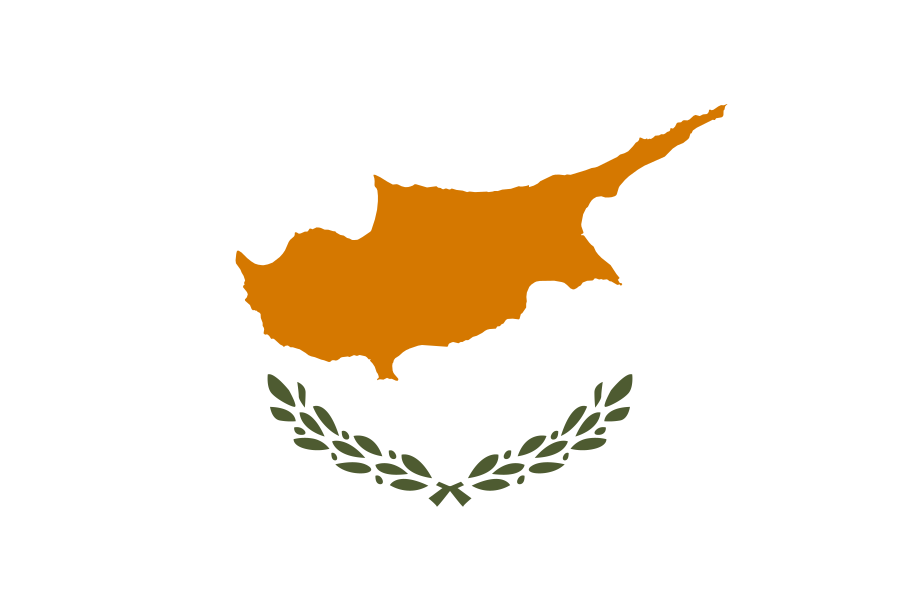
The Republic of Cyprus uses a white national flag with a copper-colored map of the island above two crossed olive branches. The current format is 2:3; its 2006 revision is distinguished here from the design first adopted in 1960.
Specification
Article 4 of the Constitution requires a flag neutral in design and color, selected jointly by the President and Vice-President. It does not supply a dimensioned construction drawing or numeric colors. The Presidency’s current description identifies a white background, a copper island silhouette and two olive-green branches beneath it. Constitution, Article 4 ↗ · Presidency: State Symbols ↗
The Pantone references are government-published color guidance, not values stated in Article 4. FOTW records the current 2:3 ratio and the earlier 3:5 format; some reference manuals retain different proportions or colors. This entry follows the current Presidency palette and FOTW’s current-format account.
Specimen screen colors
#FFFFFF / SVG fill#D57800 / SVG fill#4E5B31 / SVG fillThese are the retrieved vector’s display values, not official HEX equivalents or physical production targets. No RAL match, textile tolerance or mandatory RGB conversion is asserted.
Construction notes
The SVG uses a 900 × 600 frame, a white full-field path, a copper coastline path and a green compound branch path repeated by reflection about x=450. The two stems cross beneath the island. This symmetry is a property of the specimen; it is not inferred as a legal requirement.
The inspected vector agrees with the verified description and 2:3 format. It is an older Commons-derived repository rendition, not the Presidency’s downloadable master or the latest Commons artwork. Exact coastline control points, branch contours, emblem margins and manufacturing tolerances were not established from an official construction schedule. Preserve the supplied proportions when displaying this specimen; obtain the government master for manufacture. Provenance and geometry audit →
Symbols and usage
The Presidency connects copper with the island’s ancient production of the metal and identifies the olive branches as symbols of peace. The device is a map of the island, rather than the Republic’s separate coat of arms.
Article 4 requires the Republic’s authorities and statutory public bodies to fly its flag and permits citizens and qualifying private bodies to display it on their premises. FOTW records national and civil use both on land and as an ensign at sea; this national entry does not prescribe a separate naval construction standard.
Historical record
The Presidency dates the flag’s establishment to independence in 1960. FOTW gives 16 August 1960 as the original adoption date. The later revision enlarged and clarified the map and branches and changed the reported format from 3:5 to 2:3. Earlier specimens are therefore not interchangeable with this current-format record.
The precise 2006 chronology is unresolved. FOTW’s heading gives 24 April 2006, while its detailed account cites Ministerial Council Decision 63.673/20-04-2006 through the former Copenhagen embassy website. That primary decision and its publication or commencement record were not retrieved. Accordingly, April 2006 is used here without treating either day as a verified proclamation date. FOTW: dates, revision and reference differences ↗
Source trail
Reviewed 14 September 2026. Government text was available through indexed results; direct Presidency and former embassy endpoints failed during retrieval. No unseen construction annex is claimed as inspected.
- CyLaw, Cyprus Bar Association: Constitution, Article 4 ↗ — legal status, selection and display.
- Presidency: State Symbols ↗ — official designation, present description, Pantone references and symbolism.
- Press and Information Office: Cyprus at a Glance, 2018 ↗ — corroborating government description and colors.
- Flags of the World: Cyprus ↗ — adoption, current ratio, usage and conflicting revision dates.
- Asset register → — direct vector source, public-domain basis, credits and checksum.
Related records
Frequently Asked Questions
What does the Cyprus flag’s 2:3 ratio mean?
The ratio is hoist : fly: two units high by three units wide. For example, a 60 cm-high flag would be 90 cm wide. FOTW records 2:3 for the current format; the displayed specimen’s 900 × 600 frame has that ratio.
Why do historical references show a 3:5 format?
FOTW distinguishes the earlier 3:5 format from the current 2:3 format associated with the April 2006 revision, which also enlarged and clarified the map and branches. The original adoption was in 1960. The exact revision day remains unresolved in the imported record, so April 2006 is retained without asserting a precise commencement date. Earlier specimens are not interchangeable with this current-format record.
Is the displayed SVG an official manufacturing master?
No. It is an older Commons-derived repository rendition whose principal arrangement and 2:3 ratio agree with the documented description; its precise coastline, branch contours, emblem margins and manufacturing tolerances remain uncertified. Its HEX fills—#FFFFFF, #D57800 and #4E5B31—are screen values, not official HEX equivalents or physical production targets. Government-published guidance identifies Pantone 1385 C for the island and Pantone 574 C for the branches; those references are distinct from the specimen’s display values. Preserve the specimen’s proportions for display and obtain the government master for manufacture. See the specimen provenance and geometry audit.